






March 17, 2026
Topic
Of California’s 53 counties, 47 have published a Climate Action Plan (CAP), but only 13 of the 47 CAPs mentioned a role for private sector. Many experts agree with a Climate Policy Institute 2024 report that states: “… further mobilization of private sector investment is critical to close the investment needs gap, especially considering relatively scarce state public funds.” The preponderance of CAPs identified climate-helping activities with little or no cost benefit analysis, or without identifying a source of financing.
Now the need for private sector financing is even more acute. The new federal administration gutted climate action as soon as taking office in 2025. Plus, the variability of state budgets have comprised grant programs not relying on federal dollars.
As we kick off 2026 still intent on climate action, for California cities and counties’ perspective, there is good news and better news. The good news is that the private sector wants to make sensible climate-oriented investments. The better news is that cities and counties can add an important facilitative role.
The reason that private sector investors (banks, private equity, venture capital) want to make climate investment is that reducing GHG emissions often means profitably reducing fossil fuel use, and/or using less scarce resource – such as land and water. Leveraging nature-based solutions can sometimes be more cost-effective than technical imposition. To mobilize the climate investment, there are creative financing structures, such as shared saving contracts and guarantee structures that de-risk bank lending so that local lenders can finance climate-positive small and medium-sized enterprises.
Two examples of private sector financing are illustrated here. 1) HyWatts is a technology company using hydrogen to accomplish long duration storage combined with batteries for short duration to unlock renewables as cost effective firm base load. They tapped into real-estate financing to develop an onsite energy project for a new housing development in Central Valley. 2) Intertie is a micro-grid technology company that used a blended financing approach including a power purchase agreement to install EV charging for a that allowed a Central Valley commercial transportation company to operate its new facility off grid and avoid a two-year wait for a PG&E upgrade. The technology is well-demonstrated for providing distributed, clean energy in grid-constrained regions and this one project was successfully financed; However, more widespread and easily accessible financing mechanisms like this are needed.

Depiction of HyWatts hydrogen system (Right) for Boyd and Associates, designed to provide year-round dispatchable power supply for new residential development. Under construction 2026. Kerman California. Photo courtesy of Hywatts.
State-of-the-art 200kW solar powered microgrid, off-grid, islanded power system designed, manufactured, installed, and interconnected by Hodges Electric, Lean Solar, and Intertie.
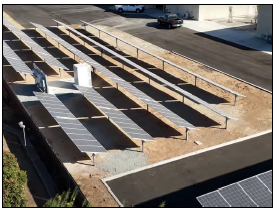
Installed 2024. Sanger, California. Photo courtesy of Intertie (Left).
In summary, for the next several years, publicly-financed grants may face additional hurdles, but private sector financing may advance. In this new financing landscape, cities and counties still hold an important facilitative role, suggesting here four functions to achieve climate goals in their CAPs: 1) streamlining and accelerating climate investment by favorable permit reform; 2) using government budget to create examples of profitable investment such as fleet electrification and heat pumps; 3) facilitating information exchange to show examples done elsewhere; and 4) serving as an independent information hub for decision-makers contemplating climate investments, especially for property and vehicle owners.