



July 28, 2026
Topic
By Bernadette Austin
What were you doing when the blockbuster film Titanic was released? Did you line up to buy paper tickets and score a first-come, first-served seat at a movie theater? Were you even born yet? The winter of 1997-1998 was memorable for an iconic film about the sinking of what contemporaries had assumed was an unsinkable ship. It was also the last time an El Niño event devastated the United States. In June 2026, the National Oceanic and Atmospheric Administration (NOAA) issued an El Niño Advisory for the 2026-2027 winter. “El Niño” events form when ocean temperatures rise for several consecutive months. According to NOAA, “trade winds weaken, warm water sloshes eastward, and surface temperatures rise across the central and eastern tropical Pacific Ocean. This major climate shift alters global jet streams, driving heavy rainfall and floods in parts of the Americas while causing severe droughts in Australia and Southeast Asia.”
Nearly 30 years ago, El Niño made the winter season the second warmest and seventh wettest in the U.S. for more than a century. California and North Dakota had their wettest February on record in 1998, while Florida, Maryland, Nevada, Rhode Island, and Virginia had their second wettest February since records began in 1895. The 1997-1998 El Niño caused an estimated $4 billion in direct economic losses in 1998, including infrastructure damage and crop destruction. Adjusted for inflation, the indirect economic impacts in the five years following that winter have been estimated at $5.7 trillion. None of these values can capture the loss of dozens of lives, an estimate of between 57 and 189 human casualties.
I remember that winter vividly. I grew up in usually-temperate San Mateo County, which even has a city with the official slogan, “Climate Best by Government Test.” This was not a community familiar with extreme weather. But that year was different. School was canceled due to power outages. I played an entire soccer season on muddy fields. The section of the rural state highway I traversed between home and school washed out and slid down the cliff face in multiple places. On this same road, my dad’s car spun out on black ice, and my car spun out and nearly hit a boulder that had fallen during a mudslide down a cliff. I was not thinking about climate change as a teenager just learning to drive under frightening circumstances. I was thinking about how the very fabric of my community was impacted by unpredictable weather. These are the visceral experiences we as climate leaders need to speak to and seek solutions for.
NOAA warns us that this 2026-2027 El Niño season could be particularly devastating in California, with high-tide flooding, changes in fish migration, enhanced formation of harmful algal blooms, and, of course, a myriad of extreme weather events. As University of California Agriculture and Natural Resources climate scientist Daniel Swain told USA Today, elevated warmth due to climate change combined with a strong El Niño season is unprecedented. “A potentially record-breaking El Niño on top of record-breaking global temperatures to begin with is a pretty big deal.”
We should take a lesson from the hubris of the Titanic builders and approach the coming winter season with humility. We can learn from the last El Niño and the more recent history of devastating wildfires to depoliticize climate change and mobilize to protect our communities. Local leaders have had to respond to constituents and community members, who often push them to prioritize affordability over mitigation and adaptation. Now is the time to lead with vision so that communities are prepared to weather the coming storms.
*Citations listed below

Gearing Up for the End of Session Sprint
By Steve Hansen, Managing Partner, Lighthouse Public Affairs
When lawmakers return from their month-long summer recess, they will enter the most compressed and consequential stretch of California’s legislative year. Fiscal committees face an August 14 deadline to move bills to the floor, followed by the Legislature’s August 31 adjournment. Governor Gavin Newsom will then have until September 30 to decide which measures become law. It is always a sprint, but this year carries added significance.
This is likely the final major legislative push before attention increasingly shifts from Governor Newsom’s governing agenda to his legacy.
At the same time, California finds itself navigating an increasingly difficult landscape shaped by a federal government that has moved aggressively to unwind many clean energy incentives and investments. The cancellation of major offshore wind projects, reductions in federal support for clean energy production, and continued uncertainty around climate policy have created new headwinds for a state that has long viewed itself as a national leader on climate.
California has also begun making its own adjustments. Policymakers increasingly recognize that achieving ambitious climate goals depends not only on accelerating clean energy adoption, but on making it affordable. The state has taken steps to preserve the long-term stability of the Cap-and-Invest program, redirected Greenhouse Gas Reduction Fund resources to protect core priorities, and shown a greater willingness to revisit policies that inadvertently increase costs for consumers.
At the same time, Governor Newsom recently announced a new round of ‘on-the-hood’ electric vehicle incentives, signaling that California remains committed to expanding clean transportation while making it more accessible for everyday families. Against that backdrop, one of the more interesting conversations this August centers on a surprisingly simple idea: allowing Californians to produce and manage more of their own
electricity.
California built its clean energy leadership through utility-scale renewable generation and a rooftop solar revolution. Yet millions of renters and apartment residents have been left behind because they simply cannot install traditional rooftop systems. Plug-in solar offers a different path. These smaller, lower-cost systems plug into a standard electrical outlet and can be installed on a patio or balcony, dramatically lowering the barrier to entry for many Californians.
SB 868, authored by Senator Scott Wiener, would remove outdated regulatory barriers that have prevented these systems from becoming widely available in California. If enacted, California would join a growing number of states embracing this technology. Plug-in solar also complements two important companion measures: AB 2612 by Assemblymember Nick Schultz and SB 913 by Senator Josh Becker. Together, these bills recognize that Californians already own billions of dollars’ worth of energy assets, including electric vehicles to home batteries and smart thermostats, that can work together to make the grid more efficient, reduce the need for expensive transmission investments, and ultimately help moderate electricity costs.
These bills also underscore an important truth: while state policy establishes the rules of the road, local governments often determine how quickly innovation reaches communities. Cities and counties can help expand access through local permitting, public education, resilience planning, and partnerships that bring new energy technologies to residents, particularly in underserved neighborhoods. California’s climate leadership has always depended on state and local governments pulling in the same direction. The affordability conversation has become impossible to ignore. Electricity rates continue to rise, placing disproportionate pressure on working families and renters while also threatening public support for California’s broader climate agenda. The most durable clean energy policies will be those that not only reduce emissions, but also lower household costs and give consumers greater control over their energy use.
In an era of federal retrenchment, California will continue charting its own course. But the next phase of that leadership won’t be defined solely by ambitious state targets or billion-dollar infrastructure projects. It will also be measured by whether local governments and everyday Californians have the tools to lower energy costs, strengthen resilience, and participate directly in the clean energy economy. Sometimes the most transformative policy begins with the simple, and perhaps even radical, act of plugging in.
First Annual CCECie Awards
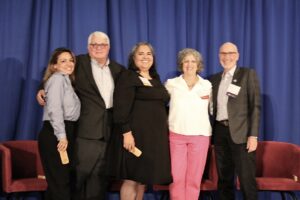
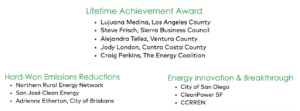
We had another great year at the California Climate and Energy Forum, which was held in Los Angeles. This year we wanted to honor some of the best and brightest in their fields, with our first annual CCECie Awards. The categories were, Hard-Won Emissions Reductions, Energy and Innovation & Breakthrough, and Lifetime Achievement. Congratulations to the winners!
Lifetime Achievement Award Winners
Upcoming Events
As we gear up for the fall conference season, we wanted to share some of the upcoming events hosted by our friends and collaborators.
Maintaining Climate Integrity in California’s Cap and Invest Program – Webinar
August 13th
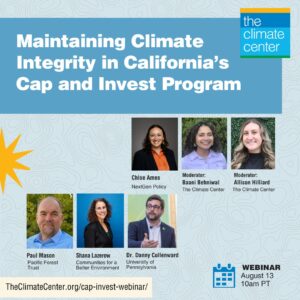
The latest reforms to California’s Cap and Invest program are the most consequential in years, and the outcomes will shape the state’s climate trajectory through 2045. In this webinar, environmental leaders, academics, and carbon market experts will walk through key elements under negotiation, including reforms to the offsets program, potential linkage to Washington, the changes in the number of allowances in circulation, and the Manufacturing Decarbonization Incentive (MDI) and its potential impact on the state’s primary source for climate funding — the Greenhouse Gas Reduction Fund (GGRF).
Decision-makers at the California Air Resources Board (CARB), the agency that oversees Cap and Invest, have given industry stakeholders far too much influence over the new regulations, putting funding for longstanding climate programs at risk. Throughout the discussion, we’ll return to the central question that should be guiding these rulemaking processes: how can California maintain climate integrity while balancing economic and political pressures on the program? Click here to learn more.
The Clean Mobility Forum
September 30th – October 1st

The Clean Mobility Forum is hosted by the Clean Mobility Equity Alliance (CMEA) Team and funded by the California Air Resources Board and the California Energy Commission. This year, the event will be held at the Tsakopoulos Library Galleria in Sacramento, CA, Wednesday, September 30, and Thursday, October 1, 2026.
The Forum is a two-day hybrid event focused on clean transportation. It brings together diverse attendees, including clean mobility project awardees, state representatives, local and tribal governments, mobility operators, community-based organizations, and nonprofits, who are committed to advancing innovative, equitable and affordable solutions to achieve zero emissions transportation, especially for under-resourced communities in California. The Forum is designed to provide participants with tools and partnership opportunities that support the implementation of innovative solutions and address the roadblocks and challenges to achieving transportation equity and clean mobility for all. Click here to learn more.
The Resilient California Summit
October 20-22

The Resilient California Summit invites nonprofit organizations, community-based organizations, local government representatives, Tribal community members, academic institutions, youth, students, and other community leaders who are directly working to advance equity and climate justice in California to apply for scholarship assistance.
Thanks to the support of our Summit sponsors, scholarships of up to $2,500 are available to help cover registration, lodging, and transportation expenses. Awards will be made on a first-come, first-served basis, with consideration for need and eligibility.
Apply by August 21 to ensure full consideration. Applicants who apply by this deadline will be notified of their award by August 31. Click here to learn more.
Please note our address moving forward:
PO Box 188800
Sacramento, CA 95818
Thank you to our Strategic Partners!