



Livable Places Update
Article
September 24, 2026
Topic
For more than four decades, CivicWell has supported local leaders transforming their vision into action, a mission that drew me to the organization in 2023. As I look forward to the months ahead, I wanted to share my excitement about upcoming events that convene civic leaders to continue this tradition—connecting like-minded people, sharing promising civic innovations, and mobilizing around common goals.
On October 21, CivicWell and the Institute for Local Government will co-host the Resilient Leaders Mixer for elected officials attending the Resilience California Summit (RCS) in Sacramento. This is an opportunity to reflect back on how far our state has come in advancing climate adaptation and resilience and to rally together to overcome the challenges ahead. Learn more about the event here, and remember to register for conference. Looking forward to 2027, I am excited to announce the return of the 35th annual Policymakers Conference at Yosemite National Park March 11-14. This year’s program includes intimate programs featuring legislators and state agency leaders guiding us through a significant transition in state leadership, as well as engaging and interactive dialogue about regional collaboration and climate disaster communication. Registration opens in November.
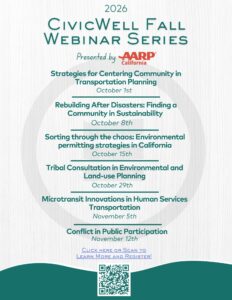
In addition to dynamic in-person events, CivicWell will offer valuable educational resources virtually. On October 1, we are kicking off the six-part Fall Webinar Series, which is provided free of charge with generous support from AARP California. There are a number of interesting throughlines in the diverse lineup. We will hear from representatives from state agencies and professionals working statewide who will provide an overview of resources that can support goals at the local level. We will explore several ways to address outreach, engagement, and participation in challenging situations to support transparent decision-making and prudent policymaking. Perhaps most importantly, we will get some valuable insights on how to navigate an ever-changing policy environment when federal, state, and local policies appear to be at odds. Even if you are unable to join live, webinar recordings and materials will be shared with all registrants. Learn more and register for your sessions today.
I look forward to seeing folks from CivicWell’s broad and growing network of members and partners in the coming months.
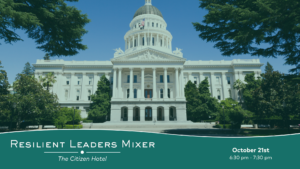
Are you an elected official attending the Resilient California Summit (RCS)? Come meet with other leaders who are creating more resilient communities in their own jurisdictions as we reflect back on how far our state has come in advancing climate resilience and make the connections critical for overcoming the challenges ahead. Refreshments and a no-host bar will be available. This event is made possible at no additional cost to conference attendees. Register by Oct. 13 to secure your spot.
The mixer will take place at The Citizen Hotel in the Scandal Bar. This venue is conveniently located three blocks west of the Safe Credit Union Convention Center and four blocks north of the west steps of the California State Capitol.
By Steve Hansen, Managing Partner, Lighthouse Public Affairs
Sacramento is approaching the end of another political season dominated by deadlines. The Legislature has adjourned, Governor Newsom has until September 30 to act on the remaining bills on his desk, and attention will soon turn fully toward November. After the ballots are counted will come transition teams, new legislative leadership and swearing- in ceremonies.
But this transition feels more consequential than the normal turn of the political calendar. After eight years of the Newsom administration, California is approaching a new governing era at a moment when some long held assumptions about how we grow, build and prepare for the future are already being reconsidered.
Housing may be the clearest example.
The strange end-of-session death of Assemblymember Buffy Wicks’ condominium construction-defect reform illustrates both the progress and the unfinished work. The bill passed both houses without an opposing vote, only to die when the Senate failed to transmit its amended version back to the Assembly before the midnight deadline for concurrence.
That procedural ending obscures a larger shift, legislators are putting more options on the table. California policymakers increasingly agree that decades of underproduction have contributed to extraordinary housing costs and that solving the problem requires more than zoning reform. Financing, infrastructure, permitting, environmental review, construction costs and liability all affect whether projects ultimately get built. Although Assemblymember Wicks’; bill died, it has set the tone for next session and the creativity of the different solutions we could see.
Voters will weigh several pieces of that debate in November. Proposition 1 would authorize $11.25 billion in bonds for housing programs, while Proposition 37 proposes a financing program for eligible purchasers of newly constructed homes. Proposition 45 would change environmental review and litigation procedures for specified housing and infrastructure projects. The measures take different approaches and present different tradeoffs, but collectively they demonstrate how much the policy conversation around building in California has changed. The same evolution is occurring around climate policy. California has spent decades leading on reducing greenhouse gas emissions. Increasingly, however, climate policy also has to address adaptation: preparing communities and infrastructure for conditions that are already changing.
Governor Newsom’s statewide emergency declaration this week in anticipation of a potentially historic El Niño is an interesting example. Rather than waiting for damaging storms, the proclamation directs agencies to stage flood-fighting equipment, identify vulnerable infrastructure, coordinate with local governments and expedite permitting for levee repairs, debris removal and other preventive work. It also directs state water agencies to help use flood flows for groundwater recharge, simultaneously reducing flood impacts and strengthening local water supplies.
That approach points toward one of the central governing challenges of the next decade. California increasingly understands many of the problems it faces. The harder task is building public institutions capable of responding at the necessary speed and scale.
Housing and climate resilience may seem like separate issues, but both raise similar questions. Can we build infrastructure before systems fail? Can we reduce wildfire risk before communities burn? Can we capture water during wet years for the dry years that inevitably follow? And can we produce enough housing before another generation concludes that homeownership in California is simply beyond reach?
The next governor and Legislature will inherit significant progress, unresolved problems and policy experiments already underway. They will also inherit a state-local relationship that will be central to almost every major challenge they confront. Housing, transportation, homelessness, water, infrastructure and climate adaptation cannot realistically be solved exclusively in Sacramento or exclusively at the local level.
That is why the months after the election may ultimately be more important than the campaign itself. Beyond who occupies which office will be a larger question about what California chooses to do with this unusual policy opening.
September will finish the work of this legislative session. November will determine who governs and decide several consequential ballot measures. Then California will begin the harder work of defining what comes next.
The opportunity for the next slate of state and local leaders is not simply to manage California’s challenges, but to build the systems needed to get ahead of them.

The 35th annual CivicWell Policymakers Conference will take place on March 11 – 14th 2027. The Conference gathers local elected officials from across California in an inspiring and collaborative environment. Registration will open November 9th, 2026. If you would like to learn more, click below.
The Policymakers Conference is open only to elected officials, strategic partners, and sponsors of this event. To learn more about sponsorship, click here.
October 20-22

The inaugural Resilient California Summit, taking place October 20-22, 2026, at the SAFE Credit Union Convention Center in Sacramento, will convene people from across the state to make progress on the policies, partnerships, and practices needed to build resilience as climate change accelerates.
The Summit will feature a diversity of interactive sessions aimed at fostering conversation, sparking new ideas, and giving attendees the resources and tools they need to be successful in their work and communities. Participants will explore key insights from California’s Fifth Climate Change Assessment, imagine the best possible future that remains within reach, and catalyze the actions needed to turn that vision into reality.
March 1-3, 2027

Mark your calendars, CALCOG’s Regional Leadership Forum, our annual statewide convening, returns to Sacramento.
Three days of peer-to-peer learning, candid policy conversation, and partnership across California’s regions. Registration opens soon, watch your inbox for the full program and hotel block.
More information to come.